
 My friend from Ireland recently sent me a photo of a lighthouse, along with the words: lighthouse down under. She was familiar with my old website that had the address lighthousedownunder and carried a picture of a lighthouse on the home page, along with my poem (see below). She did not know the lighthouse had functioned as a powerful symbol for me over many years, and I had written an essay in response to the soul phenomena that the symbol opened up.
So, here is that essay, drawn from my book Living in Uncertainty Living with Spirit and written in 1997.
**********
Lighthouse at the End of the World
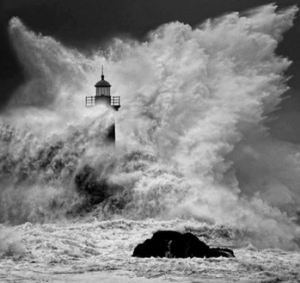
storm raging
stones hold!
ray of light
stretches the night
… touching the horizon
In 1997, I entered a Ph.D. program. This step was based on highly unusual and improbable events that had accumulated around me, acting as a sort of funnel into the future. I had no money and all other options seemed closed to me. I was despairing of my life which had been stripped down to the bone in order that I might participate in the incarnation of certain ideas that penetrated my being through the unconscious. A friend gave me the admissions brochure three times over a month and finally I accepted it, wrote out an application, and paid with a credit card. I had no idea how I would finance the program and indeed how I would even pay to get to the colloquium or buy a book.
I was accepted, although the school did send me to a psychologist who checked me out to see if I was stable enough to last the distance. My thesis concerns the phenomenon of the end of the world. It was to be a heuristic study, since I was proposing to research what I myself had undergone: an apocalypse. I proposed that the end of the world theme in literature and in actuality could be explored as a phenomenon that occurs in the transformation of the individual as much as that of the world.
The course of my program, and its eventual outcome was not planned by me in advance at all. It unfolded as I undertook the task (see Introduction) of paying attention to unusual events that penetrate my consciousness and then acting upon my experience. The single most significant event that steered me towards my goal was a dream in 1997, prior to my entering the program.
I visit Anita and she tells me she is dying with cancer, a very tender, very sad moment. We go to a busy bookstore where she breaks down and tells me that she has never been able to read books because she has never been able to find a still place inside. She has a boy friend that becomes threatening at one point. I see a lighthouse at the end of a long narrow peninsula and I feel excited about it. We must go visit it, I say.
A few days after this dream as I browsed through an online bookstore, I was startled to find a book called The Lighthouse at the End of the World by Stephen Marlowe. I immediately thought of my dream lighthouse at the end of a long peninsula. The synchronicity brought together lighthouses, books and the end of the world. I remembered also that Anita was raised as a Seventh Day Adventist. This religious denomination bases its spiritual guidance on Revelation and is centrally concerned with apocalyptic wisdom.
I began to feel that “something” in my life was gathering momentum. I felt a hidden significance to these events and they produced a moral response in me. I felt I needed to become attuned to these images, to synchronize my movements somehow to these hints.
I went shopping for Christmas and noticed a model lighthouse staring at me. I bought it. I was presented with a Christmas gift of a lighthouse calendar and on the Internet I found a lighthouse at Sequim, quite near where I lived. To get there, visitors must travel to the end of a long sandy peninsula, as in my dream. After a movie one night soon after, a friend and I drove through the city and became lost. It was very late at night and we were running low on gas. I turned a dark corner in an area of town under the freeway and there in the middle of the familiar waterfront buildings was a life size replica of a lighthouse, fully lit up, indeed a beacon in the dark night. Soon after returning home, I consulted the I Ching and received the hexagram for The Wanderer. The last line said: “Maintain your integrity! It may become your lighthouse in the sea of the unknown.”
Something was approaching me from the world through these unusual events and I did not need any more hints to pay close attention. I eagerly awaited the book that in one image combined all the hints that I had received: lighthouses, the end of the world, and books. But I was still quite unprepared for what came next. When I received the book I was immediately gripped by the synopsis on the fly-leaf which described the book as an exploration of the convergence of two realities. This is close to the language I was using to formulate the phenomenology of the end of the world. I was proposing that the experience of the end of the world in contemporary times is one in which the Cartesian paradigm, based on a principle of separation of realities is being transformed into a new paradigm, based on a principle of interpenetration of realities.
I was equally startled by the fact that the book was based on the life of Edgar Allen Poe.
Poe was a childhood hero of mine. I had his collection of Tales of Terror and read them eagerly over many years—The Pit and the Pendulum, The Maelstrom, and The Fall of the House of Usher being my favourites. Poe is unrivalled as an artist expressing the form of literature known as Gothic Romance. I also had rediscovered him more recently in connection with another dream that had announced to me: “Your life is a High Gothic novel!” (see essay From Dream to World).
My own life, the Gothic imagination with its focus on the end of civilization through the eruption of the powers of chaos or forces of irrationality and my work on the phenomenon of the end of the world, were all now linked in my imagination with the life and work of Edgar Allan Poe to whom I had been magnetically drawn as a child.
There was more to come …
My research into Gothic literature intertwined with yet another thread involving the symbols of the peacock, its connection to the comet, its role in my own life and the phenomenology of the end of the world (see essay Year of the Peacock). So I became speechless when I opened Marlowe’s book to page two and found the fictional Poe narrating his confusion about the (historically factual), missing five days of his life, just before he died: [1]
Where had I gone, those five days? And what done? And in whose company? I had been on binges before. Surely that was the sum and substance of it, a not very mysterious mystery. But then why, in hospital, in what little remained to me of afterwards, did I sometimes call myself Mr. Peacock?*
There was an asterisk and so I looked down to the footnote and read:
It cannot be said with any certainty whether or not Mr. Poe knew that the word for “peacock” in Old Norse is poe.
So now, two more threads in what seemed to be an increasingly complex fabric began to weave together. And yes, throughout Marlowe’s book there is a major role given to comets and the end of the world! As I continued my examination of Marlowe’s book I found a chapter which opened with Poe heading out to a lighthouse on a desolate island. He is trying to finish a book that had eluded him. In fact a footnote told me that when the historical Poe had died, he had left fragments of a book that was called: The Lighthouse at the End of the World. This was a thrilling discovery for me and I began to feel a weird sense that my life and Poe’s were intertwined in some way that involved Gothic romance, peacocks, comets, lighthouses and the end of the world. I read on:
His unstrung nerves were, of course, what had brought Edgar there, two hundred miles from the nearest land … His unstrung nerves were why he had been unable to finish the most ambitious work he had ever undertaken, a novel, as yet untitled, about the end of the world. Although the last few chapters remained to be written, he had not set pen to paper for months. In that time the insidious idea grew that, possibly, the story had no ending. Was it too apocalyptic? Or too far beyond his imaginative powers? It had come to obsess him, to consume his every thought, his every waking hour. He drank little, ate less. He avoided social contact, persuading himself that that was the real problem, that people insisted on bedeviling him with talk, talk and more talk, when he craved the silence to immerse himself in the ending of the work he could not finish. Soon he began to dream of a writer, rather like himself, who was obsessed by a story he was struggling—with what desperation Edgar well knew—to finish; a story about the end of the world. His dream-self, deciding that isolation was the answer, sought employment as a lighthouse keeper. (207)
I certainly could feel the relevance of his anguish over writing and finishing his book as my own in trying to give voice to my ordeal that had lasted for nearly twenty years. I eagerly turned to the beginning of the book and began to read. The structure of the book expresses an increasing complex interpenetration of dream, waking life, the fictional Poe and the historical Poe. It felt so much like the unfolding of my own life that I felt unnerved. Inner and outer, self and other, past present and future, were in such close proximity, so relativised and intertwined, that the book approached an experience of madness that I knew so well.
Marlowe portrays an uncanny interpenetration of realities that are normally kept apart, within a deeper context of an apocalypse brought about by a comet. As I read on I felt a frightening sense of dissolving structures just as Emerson describes it in The Over-Soul:
The things we now esteem fixed shall, one by one, detach themselves, like ripe fruit, from our experience, and fall. The wind shall blow them none knows whither. The landscape, the figures, Boston, London, are facts as fugitive as any institution past, or any whiff of mist or smoke, and so is society, and so is the world. The soul looketh steadily forwards, creating a world before her, leaving worlds behind her. She has no dates, nor rites, nor persons, nor specialties, nor men. The soul knows only the soul; the web of events is the flowing robe in which she is clothed.
Marlowe’s story shows a collapse of fixed structures based on opposites, leading to an apocalypse. He created a fictional Poe who intersected with the historical Poe as if to stress that fiction and history can no longer be kept apart either.
A lighthouse at the end of the world! “Maintain your integrity—it may become your lighthouse in the sea of the unknown.” A lighthouse: a place at the edge of the known universe sending out a light into the blackness of the abyss; a place at the edge, bleak, desolate, lonely, barren and dangerous—where sanity itself is tested; integrity as a lighthouse—able to withstand the storms of an apocalypse and at the same time, being a beacon of light.
My friend has a book on the table. My eyes widen for it is called House of Light, a collection of poems by Mary Oliver. [2]I tell her my tale of lighthouses and of course, she gives me the book as a gift. I open it at random and find the The Buddha’s Last Instruction: “Make of yourself a light”. Ahh! Yes! The I Ching had also instructed me and what was that dream I had, so many years ago?
I am sitting at a table. A huge wind begins to buffet me. I start shaking as it gets stronger. I reach out and grab my mani stone which is sitting at the centre of the table and begin to chant Om Mani Padme Hum—praise to the jewel at the heart of the lotus—as the wind reaches a crescendo. I hear in the back- ground a group of Tibetan monks supporting me, chanting too. The stone, the chant—I hold together. The wind abates. I have survived. The wind had pervaded my body and leaves me now with the ambiguity of whether the wind was a subtle one or my body had become more subtle. There had been an interpenetration of realities! I remembered how, in previous dreams I had simply been blown away like a leaf, by these storms.
Edgar Allen Poe died at the age of 40. He lived on the edge and was assailed by the storms of the abyss: [3]
Waves broke like thunder against the lighthouse, which seemed—was it possible—to sway … White water surged from all sides, submerging the base of the tower. The lenses of the lamp, opaque with streaming water, stared sightlessly out at the raging sea. For forty-eight hours, except for the wind and the surf, a world outside the walls of the lighthouse ceased to exist.And then it was over … Edgar prowled the living quarters until dusk … In the clockworks room once more, Edgar swiftly wrote “The Lighthouse at the End of the World”, and in the solitude resumed at last to write. (212-213)
Having survived the storm, he prepares to send a shaft of light out into the growing darkness …
***
Near the autumnal equinox of the year, late at night, I pack the last of my possessions into the car. I have released my connections to Seattle and am about to journey across the plains of Montana and North Dakota in order to join my fiancée in Michigan, a State that I know nothing about.
Floating easily at 80 mph on the thin ribbon of road that stretches across the prairies I am reminded of my solitary motor bike journey across Australia so many years ago, just before my coming here to the USA. That journey had been a prelude to an enormous leap into the abyss. I had left my beloved Anita behind in Sydney, the very same Anita whose image appeared in my dream. As soon as I had reached the USA, I began a spiritual ordeal that was to span 20 years.
I wonder if this move will carry similar consequences.
My journey is uneventful and free. I feel as though with each passing mile old skins are shedding off my back and that I am being newly born. The expanse of grassy plains is replaced by the farming fields and ponds of Minnesota until in the early pre-dawn, the time of Sophia, I arrive at the gray morning border of Michigan. I decide to go to the rest stop that is there to welcome tourists.
As I pull in to the parking area, I see a large shape emerge from the darkness. I am tired and feel inclined to ignore the lighthouse that appears, towering over me. Perhaps I am also a bit habituated to yet another one arriving spontaneously into my experience. But then I am jolted into alertness: A lighthouse! What the hell is a lighthouse doing here at a tourist welcome centre, in Michigan of all places?! I get out of my car and go quickly over to the lighthouse to read the plaque nearby. To my complete astonishment I learn that Michigan is the State of lighthouses—hundreds are preserved around its lakes and the State uses a lighthouse logo, so proud it is of these legacies.
Now I know that my arrival here in Michigan carries my destiny and that there is an interpenetration of worlds at hand. My dream has steered me to this State of lighthouses where I am indeed to learn how to be a lighthouse in a storm that was to last five more years, taking me once again to the edge of madness.
