
 I did not expect the darkness to be so dense. C. G. Jung c1960
The gathering momentum of clamouring voices sounding the alarm is, or should be, shocking. Climate Change! Irreversible! But as the younger generation may well scream, “why didn’t you do something about it earlier, when there was a chance to turn things around?” I would say to those young people that many havesounded the alarm, long before these momentous changes became visible to us all. These are our prophets, augurs, and dreamers, speaking the poetic language of image and symbol, a language no longer understood and even pilloried. I would tell these young people that the signs were there all along but in our Western culture any connection between the inner landscape and outer world has long been severed. We simply cannot understand what a dream showing the end of the world, for example, could have to do with the real outer world, if we do not naivelytake the dream literally. How to perceive and articulate a dream’s truth manifesting in the outer world while everything looks, on the surface, calm and ordered has always been the futile work of artists. They are largely ignored when it comes to concrete decisions as to what to do next, what choices to make in the real world. And yet artists must continue their work no matter what happens—there is an inner imperative to do so!
While I do not hold out hope that we can make any difference to the global outcome, there may be some value in returning to past artistic presentations to see if a connection between inner and outer reality can now be felt. I know that this connection must be felt for right action to follow. Any other basis for action seems to be off the mark to me and sure to accelerate our present course towards total disaster.
And so, an essay I wrote some time ago, along with references to other auguries…
***
When C. G. Jung was a young man, he had a powerful dream that turned his life in a new direction, i.e. into the normal vicissitudes of ordinary life: “I had to go forward—into study, moneymaking, responsibilities, entanglements, confusions, errors, submissions, defeats.” He had to turn his back on the “powers of darkness” threatening to overwhelm him:
About this time I had a dream which both frightened and encouraged me. It was night in some unknown place, and I was making slow and painful headway against a mighty wind. Dense fog was flying along everywhere. I had my hands cupped around a tiny light which threatened to go out at any moment. Everything depended on my keeping this little light alive. Suddenly I had the feeling that something was coming up behind me. I looked back, and saw a gigantic black figure following me. But at the same moment I was conscious, in spite of my terror, that I must keep my little light going through night and wind, regardless of all dangers. When I awoke I realized at once that the figure was a “specter of the Brocken,” my own shadow on the swirling mists, brought into being by the little light I was carrying. I knew, too, that this little light was my consciousness, the only light I have. My own understanding is the sole treasure I possess, and the greatest. Though infinitely small & fragile in comparison with the powers of darkness, it is still a light, my only light. [1]
Old Jung then interprets his own youthful dream, demonstrating how it engendered ethical action in the real world for the young man, even though at the time of the dream he did not yet have much understanding of it at all. He had sensed enough at the time to focus on “the little light” of consciousness as his task, i.e. to master the ordinary demands of the first half of life.
The darkness must wait.
Jung as a young man was struck by the novel idea, produced in the dream, that the radiant light of the inner world could self-present as a gigantic frightening shadow. He says, “the extraordinary idea that in the light of consciousness the inner realm of light appears as a gigantic shadow was not something I would have hit on of my own accord.” But, being Jung, he accepted the objective psyche’s ego-alien, self-presentational image. He now understood that the menacing darkness surrounding him appeared as such only when he focused on the “little light” of ordinary consciousness, as he had to do at that time of his life.
But Jung never forgot about the greater Being of the surrounding darkness. He was thus somewhat prepared when that darkness returned to lay its claim on the remainder of his life during those years as recorded in The Red Book.
****
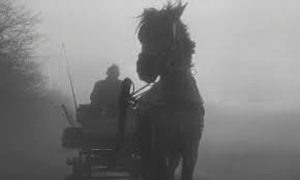
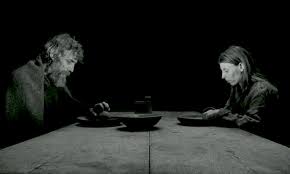
What happens when an entire culture focuses exclusively on “the little light” and, more than this, consigns the greater Being to oblivion, simply refuses to look in that direction, denies it altogether, and never returns to it?[2]
We can get a powerful glimpse of that possible future through a great art work, in this case a movie, about which one critic says, “a glorious, terrifying mystery… drills into the core of your soul.” This critic is not wrong! I have already written about The Turin Horse but more now needs to be said in response to its dire warning.[3] This movie is an artist’s stark portrayal of a single encompassing mood, slowly developed and intensified over 21/2 hours! This mood does not belong to any person (e.g. a dour man). You might say this mood belongs to the darkness that has been consigned to oblivion by an entire culture. The main character of this movie is, as in Jung’s dream, “a mighty wind [with] dense fog flying along everywhere.” The mood belongs to this wind and slowly darkens towards the final denouement.
The cinematic structure comprises six days and each day in human terms is pretty much the same as the others. A father and daughter are in a cabin, alone, utterly destitute, with home, equipment, and of course the horse, slowly degrading under the eroding power of the incessant gale—incessant! Their movements are those of automata as they go about the daily chores that keep a toehold in sheer existence, for one more day. All meaning is lost. There is no looking forward to the new day, no hopeful talk about better time, no protests about present hardships.
They take turns to sit on a stool and stare out into the grey day, with, again, the howling wind and swirling mists and dust. They share two boiled potatoes for the daily meal, taken with a bit of salt, eaten in total silence. There are no utensils. When he is done, he gets up immediately and goes to the stool at the window. She continues eating a bit more but then also stops. All the remains are emptied out. Nothing is carried over to the next day, each day being a repetition of the previous one. We are given long, long minutes of each of these utterly bleak scenes where nothing much happens i.e. in human terms…
But there is a subtle directional movement of intensification of mood that takes place as the movie continues. We get hints of this movement throughout. A friend comes by to get some palinka (vodka?) one night. This is the only scene where speech goes beyond the father’s curt commands or grunts when they bump into things in the night. The friend offers a monologue of Nietzchean thought to the father, even waxing poetic in his grim passion:
The town (civilization) has gone to ruins; everything is degraded… the world has been debased… “they” have acquired everything and therefore debased everything… everything that is excellent and noble has disappeared; everything is lost forever… I realized I had been mistaken in thinking that there has never been and could never be any change here on earth; I now know a change has taken place.
At the end of his friend’s impassioned speech, the father simply grunts, “Rubbish!” His philosopher friend closes his eyes, takes a slow breath, nods, and goes out into the night with his palinka and his poetry. Under the impact of the father’s nihilistic judgment, this final poetic moment, a brief moment of light, is snuffed out.
The next hint of a subtle movement, i.e. of a change having already taken place, as the philosopher neighbor says, takes place in the dead of night. The father says, “Did you hear that?” His daughter says, “What?” “For fifty six years I have heard the wood worms. Now they have stopped.” They go back to sleep. The next day, their horse, i.e. the Turin horse, refuses to move or eat. So they simply go back inside the house and sit once more. Gypsies arrive seeking water from the well—a wild, chaotic band. He goes out and threatens them, so they curse him. The next day the well dries up. He says, “We have got to leave.” A long slow preparation takes place as they pack everything in a cart, leading the horse behind them, and strike out, The camera shows them going up a long slope and over the brow of a hill out of sight. Some seconds later they return and unpack everything, putting the dying horse back in the barn
They have failed in their last bid to escape their fate.
During what appears to be their final meal, the light finally goes out! This a black and white movie and the screen dies to a total black. Her voice says, “What is that?” He tells her to light the lamps. She does so but, one by one, they go out even though filled with oil. Total darkness prevails. Later they are at the table but they both finally cease to eat.
Throughout this movie, we enter an ever-deepening mood. At no point does the expected “I can’t take this any more!” arise. This mood, with its accompanying dreary music, does not belong to any character. It is a mood of inevitable, ineluctable, and final withdrawal of the light, the light that animates everything, that endows life with Meaning, the light without which we are reduced to automata, like the father and daughter. Their philosopher friend speaks of those that acquire and debase everything. This outcome occurs when we focus exclusively on our “little lights”, the light of ordinary consciousness, and ignore the greater light that surrounds us and informs us. This greater light must now appear dark and menacing, as Jung discovered as a young man.
Unlike our culture today, however, he never forgot the greater One and when it announced itself again, he welcomed the coming guest.
Our modern cultural practices have not done so. We have shut the door from the inside against the coming guest.[4] The Turin Horse gives us a compelling portrait of what may happen, indeed could already be happening, if we focus exclusively on our ordinary consciousness, only on what is directly in front of us—a culture that refuses to look beyond.[5]
The Turin Horse shows us one vision of the endpoint of this insane refusal: the light, which is now an unendurable and pressing darkness, finally withdraws. The Turin Horse also unsparingly demonstrates what happens to human beings when the life-bestowing light, the coming guest, finally turns away. [6]
A last word from Leonard Cohen
Some companion essays:
- Darkness Looming Behind the Scenes
- Jung’s Legacy in This Time of Darkness
- Snowden: The Darkness Gathers
[1] C. G. Jung: “Student Years” in Memories, Dreams, Reflections.
[2] See my post, The Shootings. Also my book, Oblivion of Being:
[4] See my essay, Light of the World
[5] See my post, The Shootings
[6] Scenes from The Turin Horse:
and
