
 I can see planet Earth from space. Cracks are beginning to spread across its surface. Earth is silently coming apart; the “glue” that holds everything together, i.e gravity, is withdrawing. Now I am stranded on a small island in space, a fragment of Earth, while others occupy fragments of their own. We can still communicate, but our oxygen is running out, and we will all eventually die. It was all so silent!
Is this merely another apocalyptic dream?
As the global crisis deepens, such visions of the end of the world seem increasingly to reflect actual events. What, then, might one more nightmarish image contribute to today’s dominant narratives of despair?
Our lived world is structured by materialism. In this essay, I argue that the logic of matter is undergoing a transformation, one that demands new language to articulate both emerging forms of material existence and a new conception of the desiring subject. My apocalyptic dream stages the possibility of this transformation as a horrifying image.
THE GRAVITY OF OUR CRISIS
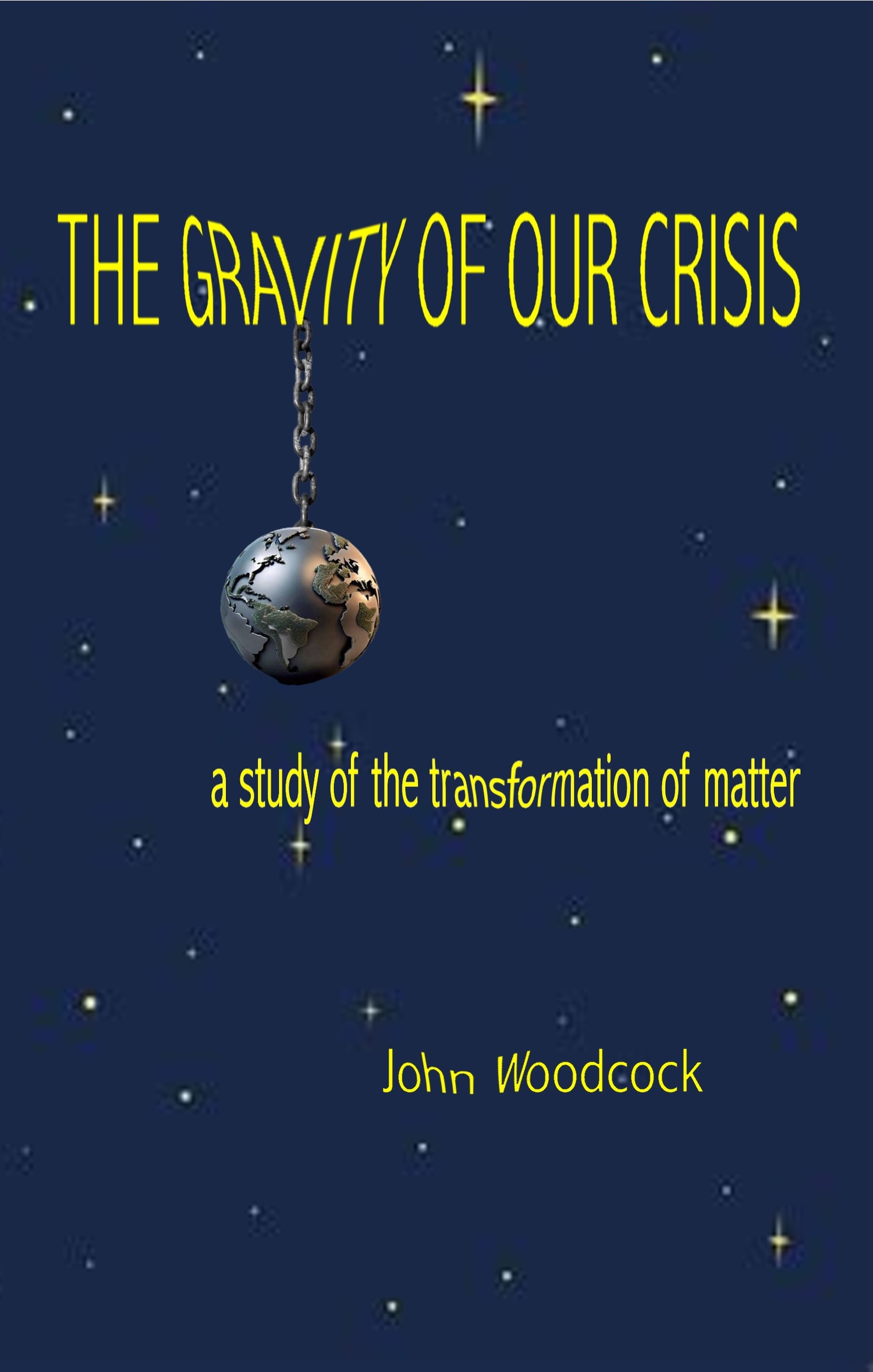
Kindle version here!
PREFACE
This entire essay springs from a dream in December 2025. It has had me in its grip since that time. I have already written two essays based on the dream, and, as well, a poem-video.
The dream struck me in terms of its visceral quality, about which I have written (see Introduction here). Visceral dreams have a material effect on the dreamer and seem to be highly significant in the age of materialism that we are living now. But dream theory almost universally does not take this ontological background into account when approaching dreams. Dream work customarily supports the now-obsolete two-world paradigm, (the ideal/real split). Dream images are regarded metaphorically, symbolically, but not materially or viscerally. I began a search in recent years for some philosophical support for my claim that dreams today are most significant as harbingers of the future when they affect us viscerally or materially, as I explore below.
I finally found the support I needed in Slavoj Žižek’s philosophy of radical materialism and I immersed myself in his books, essays, and videos. I was inspired to engage CHAT GPT in order to learn the rhetoric of radical materialism as originated by Žižek so that I could further interrogate my apocalyptic dream with its unusual visceral quality. For most dream commentators, this visceral quality is ignored in favour of interpretations that privilege the ideal.
Here is the dream:
I can see planet Earth from space. Cracks are beginning to spread across its surface. Earth is silently coming apart; the “glue” that holds everything together—gravity—is withdrawing. Now I am stranded on a small island in space — a fragment of Earth, while others occupy fragments of their own. We can still communicate, but our oxygen is running out, and we will all eventually die. It was all so silent!
The dream presents physical or material images (Earth, cracks, glue, gravity, oxygen) that resisted my attempts to symbolize them or to interpret the dream in terms of familiar meanings or interpretations. The dream confronted me with the physical concept of gravity. In physical or material terms the dream presented an impossibility! Physical gravity simply does not “behave” in the way shown in the dream. Yet I was “tasked” with responding in some way to the dream’s persistent pressure on me to articulate, somehow, its truth.
Months later, I produced this essay in response to the dream. I engaged CHAT-GPT on a daily basis to assist me with vocabulary and conceptual precision. I found important philosophical backing for my response in Slavoj Žižek’s radical materialism which I discuss more fully below. I slowly discovered over subsequent months of arduous effort that the surprising truth of my dream constitutes a challenge to two fundamental background structures of our lived world today — our current abstract concept of gravity and our current abstract concept of the self.
This challenge gradually unfolded into clarity as I kept refining the questions posed to CHAT, as we will see below. Here I want to open the discourse by briefly discussing the difference between an abstract universal and a concrete universal — this philosophical difference surprisingly becoming central to the meaning unfolding from the dream.
The concept of gravity today functions as an abstract universal category referring to a physically real, dynamically structured background order that makes intelligible the vast multitude of physical relations constituting our material existence (falling bodies, planetary orbits, gravitational lensing, gravitational waves, etc.). Each particular perceptible gravitational event is understood to be an instance of universal gravity. A falling apple is merely one particular instance of universal gravity at work.
From my studies of Žižek’s radical materialism, I knew that the concept of a concrete universal is crucial to his work of radicalising the notion of materialism for the 21st century. In general a concrete universal exists, unlike an abstract universal which remains ideal, or simply a category of understanding. I decided to ask CHAT to compare them. While our discussion went more deeply into the comparison, I’ll briefly state it here: an abstract universal is a general category imposed on different individuals: “All citizens are equal before the law.” Here, “citizen” is treated as a fixed category, while particular people are merely instances of it. A concrete universal, by contrast, is produced when a particular case exposes a contradiction within the universal and forces the universal to become more genuinely universal. The concrete universal is not a neutral rule standing above its examples; it is a contested field that is transformed by its excluded or marginal cases. That is, the concrete universal appears in a particular struggle that both belongs to the universal and reveals its incompleteness.
My dream forced me to consider this difference as we will see and the difficulty in this task at one point inspired me to pose a question to CHAT:
User prompt :
Has anyone in modernity, starting with Žižek, explicitly taken up the question of gravity as a concrete universal?
GPT-5.6 Luna
Not in any well-established or widely cited sense. There does not appear to be any recognized modern philosophical literature that explicitly develops gravity as a “concrete universal” in Žižek’s specifically Hegelian sense.
I pressed on into the darkness…
