
CORONA VIRUS AND MATHS
(A Satire: wait until the end)
The corona virus doubles every few days, making its expansion exponential.
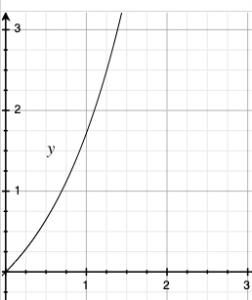
An exponential curve is written like this: ax, where a is fixed positive number, a>0 (the base) and x is a positive variable, x>0, called the exponent. So, if x is time, say number of days, we get the exponential curve:
But the corona virus is likely modelled by a more complex equation and the most famous one is called the logistic equation, frequently used to model the spread of disease, for example. Probably the corona disease is modelled with some version of this:
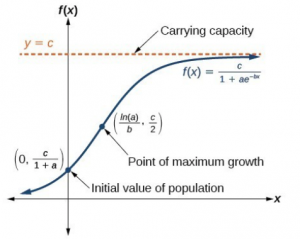
Such models show how disease spreads rapidly but then tapers off as limiting factors come into play (such as total population, c, how fast it spreads, b, etc.). The exponential term, e-bx is the decay term that “dampens” the spread of the disease.
But what about the simplest exponential equation, ax ? The base, a, is usually a positive number and x a positive variable. This yields a rapidly rising exponential curve as I showed above but is there any version of this simple exponential curve that would have a decay or decline in the curve anywhere?
What would such a curve look like, I wondered, if both base and exponent were variables, such as: Y= X x
Let’s find out!
a) An easy point on the graph: when X = 1 , Y = X x or Y = 1.
(1,1) is on the graph.
b) What about X = 0 ? Y= X x so Y = 00 ??? Undefined! :
(0,?) is a singularity.
c) Let’s make the the Domain X > 0 , X x will also only have positive values, i.e. Y > 0. So, the graph is entirely in Quadrant 1. For x>1, the curve will look like an ordinary exponential function (see above) but we need to be a little careful when 0<X<1.
d) So let’s take a look at the first derivative dy/dx (the gradient of the curve).
dy/dx = ?
Let’s first take the log (ln) of both sides of the function:
ln (Y) = ln (X x ) = X ln(X).
Now differentiate.
(1/Y) (dy/dx) = 1 ln (X) + X (1/X) = ln (X) + 1
The derivative of both sides is now easy:
dy/dx = Y[ln(X) +1]
e) Any stationary points i.e. where dy/dx = 0 ?
Y is always > 0 (see above) so can ln(X)+1 = 0 ?
ln(X) = -1
or X = e-1= 0.367 and Y = (e-1)e^-1 = 0.692.
f) So curve is horizontal at that point (0.367,0.692) but is it a maximum or minimum value for y, i.e. is the curve a mountain or a valley at the stationary point?
Trial points: (0.2, 0.6428)(a bit before X=0.367) and (0.4,0.693) (a bit after X=0.367)
At X =0.2, dy/dx = -0.166 i.e. downward slope (negative value) and at X=0.4, dy/dx=+0.36 is an upward slope (positive value). So we have a valley and thus a minimum value for
Y = 0.692 at the stationary point.
g) Putting all this together:
Domain: X>0;
Range: Y>0;
One stationary point at (0.367, 0.692), with a
Minimum value of Y = 0.692; and
A singularity at X = 0
Our graph looks like this:
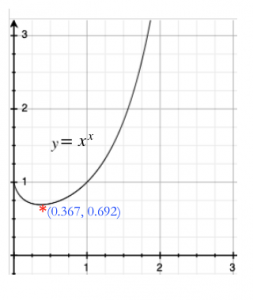 Amazingly there are some values for X, namely in the range 0<X<e-1, where there is a dip or decease in the curve. This may be the only equation of a simple exponential where a dip occurs like this! Exciting! You could say that it trends down for the values 0<X<e-1!

What, you ask, is the relevance of this little excursion back into undergrad maths (I used to be a maths teacher—dual career, or maybe three careers: therapist, teacher, writer.)?
What could this equation model?
I don’t have the faintest idea BUT it’s a way to spend an afternoon in self-quarantine! And, I am not the only one today fixated on useless models of exponential growth!
Useless in the sense of having any effect on what is coming….
