
“TWO-HEADS”: FOLLOWING THE HINT OF A DREAM
A few nights ago I had this dream:
I am walking in public and learning for the first time that I have two heads, learning through the responses of others to me, as they looked at me. My ordinary consciousness was “located” more in one head but the ego-alien head was also seeing the world.
At any point, with any dream, I could break off from the dream and search for its meaning in past associations, historical analogies, etc. But instead I stayed close to the imagery and began to ask some simple phenomenological questions. My train of thought ran along these lines of inquiry: We normally have two eyes, each having a slightly different perspective, giving consciousness spatial depth. Two heads, then, would each gain spatial depth but what would the four eyes together perceive in the way of “depth”? Another dimension of depth altogether! And, apparently, I am waking up to this possibility of perception.
I knew that phenomenology poses an “ultimate” question for its discipline which normally asks us to describe objects from whatever our perspective is at the time. Thus, if I shift my perspective just a little, an entirely new set of objective qualities emerge to be described. If we follow this procedural logic, we are led to the question of what would we perceive if we gained the capacity to see the object from all perspectives, or all sides at once—a 360 degree “vision” if you like.
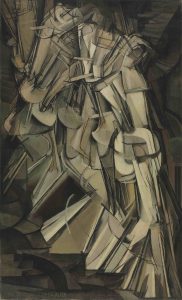
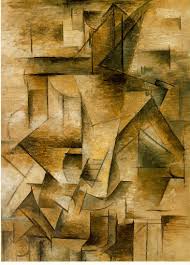
Artists such a DuChamps and Picasso tried to disclose this perceptual capacity to us, for example, showing us what a nude descending a staircase would look like if we could see the descent all at once, and what a body would look like from all directions at once;
In following the hint of a dream, there is nothing to tell you that you are right, that, yes that’s it, that’s the way to go. We need quite different criteria from those of formal logic, (for example, starting with “x” we can deduce “y”, etc.) The criteria I cleave to over decades of paying attention to my dreams and writing in the peculiar way I do, is this: Although there are many details in a dream that I could pay attention to and “follow up” with amplifications, interpretations etc., the detail that matters to me is the detail that initiates an imaginal flow! It is the flow of imagery, or thought that matters from then on.
And so, when I focussed curiously on the kind of consciousness that correlates with “two heads”, along with what kind of world that consciousness would perceive, I felt a trickle of movement start up, which quickly turned into a flood that heated my body like a lamp.[1] This “movement” was my guide from that point on and, from past experience, I simply “went with” whatever attracted itself to me, like a moth to flame, the memory of Merleau-Ponty’s phenomenological question constituting the first trickle.
From there a torrent burst in! The Internet can move as fast as my fiery stream, so I was soon intensely hyper-linking from Google and was quickly rewarded with this title to a YouTube video: “Encountering Dali in the 4th Dimension”, by mathematician Tom Banchoff.[2] Well, what subsequently transpired has led me into an entirely new direction of enquiry, requiring me to break off from time to time in order to cool down enough to continue with the next flood. My lovely partner Anita listened to my heated speech enough to tell me she didn’t know what I was talking about—exactly the feedback I needed so that I could work harder to make it intelligible to her and others.
What opened up for me will require more essays than this, as I am still very much in the heat of it BUT I can say this much for now. Salvadore Dali is described as a modern artist who could actually “go” to the 4th dimension and show us what the real world looks like from that perspective, i.e. as the 4th dimension unfolds into our reality. He calls his method the “paranoic critical method”—a kind of spontaneous explosion, or delirium that is injected into reality, not mechanically, but in a deforming manner, changing the nature of reality itself. He calls it a terrestrial imagination, an imagination of physical reality injected with something else that he calls his delirium. The unity of these perceptions (ordinary and extra-ordinary) constitutes Dali’s art and indeed his personal life too.[3]
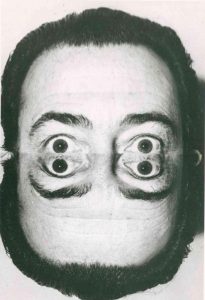
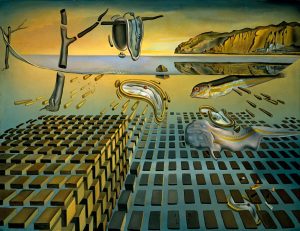
Dali is showing his version of an entirely new set of real appearances that correlate with a new style of consciousness—one that can simultaneously perceive ordinary, hardened, empirical reality and the reality of another dimension altogether, as this dimension unfolds into empirical reality.[4]
Now I received another explosion of memories, associations that I will share later on (I am still trying to hold on to my hat here as they continue to come in). I have gathered some books from their titles alone and only now do I understand what I was drawn to. I also have dog-eared book-pages that I have read many times over the years and only now do they make sense to me. All this will emerge in later essays.
As I close this essay for now, to catch my breath, I will leave you with this enticing thought. Many modern artists, from Kandinsky on (particularly Klee’s Angel series for me), to Dali and others, have made a supreme effort to make visible to us a new possibility of viewing the real world, a new way of being, if you like. This new way involves a unity of two forms of consciousness—ordinary empirical reality and what I will call here a perception from the 4th dimension: ordinary empirical reality from the point of view of the 4th dimension as it unfolds into reality. Dali is showing us how the ordinary world appears when we can perceive it as the unfolding or injecting of a new dimension of experience into the ordinary real world.
I will show how this insight is nothing less that a description of the process of the historical descent of Love into the hardened material world, with all the suffering and distortion that follow. Salvadore Dali’s personal life is one agonising expression of this dreadful, yet mysterious and profound, almost completed, descent of the divine into the ordinary, as is his art.
[1] I describe my past experience with this heat is my books. It leads to an unusual style of writing.
[2] https://www.youtube.com/watch?v=0AMt4ppZQFE&list=WL&index=2&t=1s
[3] I will try to explicate all of these terms and ideas in future essays.
[4] Dali was fascinated by science, nuclear physics and the psychology of the unconscious.