
A “task” dream generates a strong sense of “I must act” in response to the dream. The dream experience includes a sense of authority, not easily ignored. The task seems to also carry a felt sense of having to do with my destiny, what I am here to do, even if I do not have the faintest idea how to act or what to do, specifically. So the “task” means, “my task in life”, my calling! “Task” dreams deliver such an impact on the dreamer that the sheer momentum of the dream phenomenon may alter the course of his or her life.
I had recently arrived in Los Angeles (1979) and shortly after entered Jungian Analysis. I have no memory of how I heard about Jungian Psychology, or the Institute there. Nor had I any particular regard for my dreams. As my analysis began I had two dreams that shocked me:
I take two extremely poisonous and beautiful snakes and free them. They begin to make love to each other while I lay between them. We thus form a caduceus. I believe they will not harm me as long as i am still. I am correct. They move on and around me.
I am lying down in my analyst’s room alone. A large erect cobra is watching me silently from the floor. I close my eyes and remain still. The cobra flicks his tongue in and out of my mouth. As He does so, I feel an indescribable feeling of being loved. Then He leaves.
At the time I had no idea about the mystery of Kundalini, or of the serpent power. I had no knowledge of stillness as a soul quality that might be necessary for a particular soul process to unfold. Yet I behaved “correctly” in the dream. These, and other such dream phenomena, wrenched me out of a kind of lost wandering kind of life onto a path that I had to follow. I thought at first that my task—the task generated by the dreams–was only to understand what was happening to me. That is to say, my incorrigible Aquarian “need to know” dominated my conscious concerns. The correction came about via dreams that brought into question everything I “knew”, time and time again. I was thrown into the unknown so often that, finally, I surrendered. I learned to live with not knowing.
My task had to do more with living differently, and not with knowing more while living the same old way. As I aligned more and more with the telos of my inner life, or, if you like, my destiny, my dreams further refined the formulation of my task. And so, a while ago (2010) I had the following dream:
I am with my son in his apartment. I am finding my way back to the apartment but get lost and am wandering around. I find my way to a group of people who welcome me in. They seem to know me, expect me. I tell them about my life, my dreams and this seems to confirm the rightness of my being there. Then I enter a dream state and am looking for someone, something. I can do this quite objectively. When I return they tell me that is why I am here. I have the capacity to enter the unconscious objectively. I am needed to find the birthplace of a little girl who is the next “one”. The one the group is waiting for.
In contrast to my former dreams in 1982, this one explicitly states my task—“I am needed to find the birthplace of a little girl who is the next ‘one’”. I am explicitly tasked within the dream. The “task” is now appearing as an aspect of the dream phenomenon. Jung taught, “it is … a grave mistake to think that it is enough to gain some understanding of the images [of a dream] and that knowledge can here make a halt. Insight into them must be converted into an ethical obligation.”[1] He was referring to action in the real world that can help bring some aspect of the dream into manifestation or incarnation. I therefore now received two senses of a task, one task that was enacted in the dream and another task awaiting me in waking life, springing from the work of understanding the dream in some way.
I then promptly forgot about the dream, under the considerable pressure of two frightening dreams that quickly followed—dreams of death! [2]
I lost my job. I am looking for new work as a maths teacher. Surely someone needs me. I am on a motorbike going along a street the wrong way. It is one way the other way. Someone indicates so and I acknowledge. Now I notice my right leg. It is almost eaten away around the bone, which is quite exposed. Flesh is hanging off. It has obviously been this way for some time. Well, there is no going for work now. That is over! I am under a tree and a dog comes, sniffing. He goes for my leg. At first I am alarmed then realize it is only food for him. A horse comes by. Now, some people come. They are from the organisation that assists with the passage across. I am relieved and I start weeping. Memories come and I finally remember my son Chris, I wish he were here but that is not to be. I lie there quietly. I see a skull. It is mine but how can that be? As I turn it slowly in my hands I marvel at how at one time my brain was in there. Now the time is close I feel my breath going and I ask to be taken under the tree to go quietly.
And then the second dream:
I decide to kill myself. A bullet in the head, but it does not kill me only knocks out brain functions. So now I am alive but in a very different way. I see Viv, (who killed himself) who tells me that meningitis is next. I move into a flat in an inner city area, almost slum, where I will become the “Sage of Underwood” or some such. Kate, the actress from Underbelly, sings nearby to me and the song is beautiful; just beautiful.
These dreams, with their emphasis on the physicality of ineluctable death, rocked me. I became frightened. I was going to “die” and there was no going back. The finality of death was shocking. But there was also something else going on. Both dreams pointed to a kind of mysterious existence that is “beyond” a brain-based consciousness (reflective consciousness), requiring its death. How could I contemplate my own skull and how could I “be alive but in a very different way”, having no “brain function”? There was something urgent about the dreams’ insistent focus on that death, as well as another, new way of being, presented to me in such stark imagery. They were accompanied over the next few years by a persistent attack on my desires to return to “old ways”, in the form of repetitive dreams that reinforced the sense of such regressive desires as “going the wrong way”, as my first death dream says. Finally, only this year, they culminated in a dream in which I tried to go back to old ways and experienced a visceral revulsion within the dream at the same time. My body’s wisdom thus taught the final lesson and I “gave up” my tendency to think along old habits of thought. I faced a very uncertain future.
And now only this week (Nov 2017) the memory of my dream, in which I discovered my dream task of finding the birthplace of the next “one”—a little girl—returned to me. But how do I now, in waking life, attempt to bring any aspect of that dream into actuality—i.e. my ethical obligation as Jung puts it? To put it another way, what connection lay between my dream task of entering dream states consciously in order to locate the birthplace of the next “one” and any task in my waking life that constitutes an ethical obligation? Adding further to the complexity of this nest of images are my death dreams as well, which now must be considered.
It seems that in order to prepare me for my dream task of “locating the birthplace of a future one,” my reliance on “brain consciousness” had to be severed by death. The method, shown in the dream, of “locating”, does not involve memory or images of the past. My entering the unconscious consciously must therefore involve new soul capacities, i.e. finding a “birthplace” without the benefit of a map, or any reliance of the past. The “next one” is of the future. So the location of her birthplace cannot be a matter of recognition.
Could it be a new kind of perception? I say this because the possibility just now leaped at me—a capacity to perceive in a completely new way, one not based on reflective or brain consciousness but something else entirely. Earlier this year I had a dream which led me to the work and life of Salvador Dali and an examination of his unique artistic method he called his paranoiac critical method. The dream that led me to Dali begins (extracted from that essay): [3]
I am walking in public and learning for the first time that I have two heads, learning through the responses of others to me, as they looked at me. My ordinary consciousness was “located” more in one head but the ego-alien head was also seeing the world.
I go on to explore the dream this way:
At any point, with any dream, I could break off from the dream and search for its meaning in past associations, historical analogies, etc. But instead I stayed close to the imagery and began to ask some simple phenomenological questions. My train of thought ran along these lines of inquiry: We normally have two eyes, each having a slightly different perspective, giving consciousness spatial depth. Two heads, then, would each gain spatial depth but what would the four eyes together perceive in the way of “depth”? Another dimension of depth altogether! And, apparently, I am waking up to this possibility of perception.
My essay on Dali explores this new kind of perception in more detail with reference to his Surrealist art but here, in writing this essay, I felt an immediate connection with my present enquiry. What soul capacity is needed to “locate the birthplace” of a future potential (pictured as a young girl)? Now I understand that a new perceptual capacity is called for—a new way of perceiving “depth” as it is “coming to be”—its “birthplace”, as it were.
One of Dali’s paintings, “Dream Caused by a Bee …” can give us a sense of this “depth coming to be”:[4]
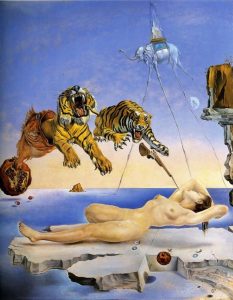
This content of this painting is rich in symbolism and indeed has been interpreted along religious, or psychoanalytic grounds. But I think what Dali says about his method is much more to the point of what he is getting at in his artwork. He wants, “to materialize the images of my concrete irrationality with the most imperialist fury of precision… and make the world of delirium pass onto the plane of reality.”
For me, the key to understanding Dali’s opus thus lies in the images as movement, pictured, or frozen as the content of the art; and further, his intuition about the direction of that movement, i.e., “onto the plane of reality”! Here we can see that, as he was emerging from sleep to wakefulness (the hypnogogic state), he detected a psychic movement, transformational in quality. We have to “feel backward” from the frozen artistic representation to the movement itself, which lies “beyond”: From a “birthplace”, pictured as a pomegranate, a movement starts up, or leaps. The painting gives us a hint of Dali’s experience of this self-moving, transformational movement. Dali’s work is an artistic rendering of what he perceived—movement as becoming—a possible future being born!
In my dream, I was given the task of “locating the birthplace” of the future or the next “one”, pictured as a little girl. For now, let’s call that “birthplace”, “Dali’s pomegranate”. The new soul capacity is a perceptual one:
whispers,
faint stirrings,
a glance,
embryo,
trickle tumbling quickly into a torrent,
cascading leaves
pouring down
webs blowing in the wind
wispy threads …
gone
As I was writing, I “detected” Dali’s pomegranate and images started up. I followed them as they were forming, and the short “poem” above was released, ever so briefly, before it stopped and I now return to my more prosaic writing here. But this moment could give us a hint of how the new perception “works”. Dali was a brilliant artist and could render his perception in beautiful art forms. But the movement springs from a place where colour, sound, form, touch are not yet divided. From Dali’s pomegranate springs forth into actuality psychic movement as word, image, sound, gesture, or colour.
We could also call Dali’s pomegranate a universal language from which all forms are “born”.
My “task” dream also, as I said, generates a task in my waking life according to Jung’s dictum (see footnote [1] above). I conceive my task this way. How can I live my waking life as a preparation for the possibility of finding my way to Dali’s pomegranate from which possible futures are born? It seems clear to me from my “death” dreams, and from the mythological fact that pomegranates and the underworld are closely associated, that the new perceptual capacity required for welcoming the unknown future, is born from death. To locate the “birthplace” of the next “one”, we must die to our “brain” consciousness, based as it is on memory, reflection, and familiarity of fixed form. We must also cultivate the kind of practice that is hinted at by the words of my poem above—suggestion, playfulness—saying yes to absurdity.
Cultivating these qualities constitutes a cultural practice that is resonant with a deeper task at hand—a task given us by psyche—my dream task. This deeper task involves our conscious participation with forming futures, co-creating them. How we participate is crucial to the outcome. Dali seemed to participate with joy, exuberance, and an incredible level of playfulness. We see the world that can be created from such conscious participation though the medium of his art.
[1] Memories, Dreams, Reflections, 235.
[2] I explore these death dreams in more detail in my book, UR-Image. For a free pdf copy: https://www.dropbox.com/s/q3g78gzjshy3h8d/ur-image.pdf?dl=0
[3] My entire “Dali” essay may be found at: https://www.academia.edu/34714229/DALI_Deformation_of_Reality
[4] Extracted from my “Dali” essay