
 A New Appearance in the World
PERSONAL NOTE:
At this time (July, 2017) I sense the pressing down of an unbearable darkness.[1] We are “in it” now and there is no getting out, for anyone. It feels very close, and as I said, pressing down on us. I keep writing, not in any hope, but to say what I see, have seen for many years—a beam of light, a narrow bridge, a way through for those who can also see what is invisible—the objective psyche and its secret movements.
I look around to find “companions”, those individuals who also see the workings of the psyche through and within the deepening chaos. They may use different vocabularies, work in different disciplines, yet are seeing the same invisible reality at work though our sensible world.
Such a man is Arthur C. Danto, art philosopher, art critic and author. I hadn’t heard of him when I was startled by the title of his book, Transfiguration of the Commonplace. I had to find out more. I ordered his book and scoured the Internet for essays, blogs etc., anything I could find on his work. Is he talking about what I would be talking about if I used that rhetoric?
Finally his book arrived and I dived in. When I surfaced days later, I wrote this essay, concluding that he is indeed talking about “the same thing” as I have been for many years—more learned, more scholarly, more eloquent, to be sure, but he is addressing the reality of the objective psyche as represented and externalised in contemporary art works. He knows where to look!
Danto found a new real appearance in the art world (did you know he invented the term, Artworld?). This new appearance gives us access to an experience of the infinite depths of psyche as the interiority of commonplace real objects—a new real appearance that brings to a closure the gap between consciousness and world.[2]
Let’s read on together …
TWO EPIGRAMS
This is equivalent to asking what makes it art, and with this query we enter a domain of conceptual inquiry where native speakers are poor guides: they are lost themselves.
Arthur Danto
As a work of art, the Brillo box [Andy Warhol’s Pop art—see below] does more than insist that it is a Brillo box under surprisingly metaphoric attributes. It does what works of art have always done—externalising a way of viewing the world, expressing the interior of cultural period, offering itself as a mirror to catch the conscience of our kings.
Arthur Danto
A LITTLE HISTORY
The things of the world have not always appeared the same to us. We know that around the 19th C. for example, the Metaphysical world came to an end and the things took on a radically different appearance—they went from being God’s creation, to simply being resources at our disposal, making possible the Industrial Revolution and all that followed. All appearances throughout history are logically constituted in the sense that their mode of being is determined by an underlying logical structure (the objective psyche). For example in the Metaphysical world, the logic of the copula prevailed. So, although we could sensibly perceive that one thing is not another thing, we also felt the truth of the two things being also super-sensibly identical (in God, for example). This logic was portrayed as the Great Chain of Being in which all things, although separate, also participated in divinity.
Then it all fell apart! The logic of the copula gave way to the logic of difference, which informs an entirely new mode of being for things. They now appeared as separate from one another with no reconciling unity in divinity, thus becoming mere resources to be used in any way we desire, along with all the consequences for culture, epistemology (i.e. what we can know about the things), that we still struggle with today—a total disenchantment of the world!
We can fight for, and on behalf of, this now disenchanted world, and many souls are doing that necessary work as our collective crisis deepens! But we alone cannot re-enchant the world. The contours of the world, i.e. its appearances, are determined by an underlying logic that we cannot control. That logic may transform and if and when it does, we can and I would say, must, notice the fresh appearances that arise from the new logic and begin to synchronize our lives to the new logic and its corresponding appearances in order to inaugurate a new life-world.
There are signs that such a new appearance is emerging, informed by its underlying logic!
Some have noticed it within the art world. And they have begun to speak it …
THE ART WORLD
A new appearance is an anomaly. It cannot be “known” as familiar objects can be known, and if it is not dismissed, this anomaly begins to shake up an entire world. Within the art world such an anomaly appeared and changed this world forever. And the logical implications go beyond the art world. When art philosopher Arthur Danto began to speak this anomaly to his colleagues in 1965
I had the morbid satisfaction of not having it understood at all. So it might have slumbered in back number of the sepulchral Journal of Philosophy were it not discovered by two enterprising philosophers … who gave it modest fame. I am very grateful to them, and additionally grateful to those who erected something called the Institutional Theory of Art on the analysis of “The Artworld,” even if the theory is quite alien to anything I believe: one’s children do not always quite come out as intended. I nevertheless, in classical Oedipal fashion, must do battle with my offspring, for I do not believe that the philosophy of art should yield herself to him I am said to have fathered.[3]
So, what new appearance did Danto discover? He leads us into his argument by noting an historical episode:
Some such episode transpired with the advent of post-impressionist paintings. In terms of the prevailing artistic theory (Imitation Theory), it was impossible to accept these as art unless inept art: otherwise they could be discounted as hoaxes, self-advertisements, or the visual counterparts of madmen’s ravings. So to get them accepted as art … required not so much a revolution in taste as a theoretical revision of rather considerable proportions, involving not only the artistic enfranchisement of these objects, but an emphasis upon newly significant features of accepted artworks, so that quite different accounts of their status as artworks would now have to be given … the artists in question were to be understood not as unsuccessfully imitating real forms but as successfully creating new ones [my italics], quite as real as the forms which the older art had been thought, in its best examples, to be creditably imitating.[4]
He then produces an illustration of this new appearance:
Logically, this would be roughly like printing “Not Legal Tender” across a brilliantly counterfeited dollar bill, the resulting object (counterfeit cum inscription) rendered incapable of deceiving anyone. It is not an illusory dollar bill, but then, just because it is non-illusory it does not automatically become a real dollar bill either. It rather occupies a freshly opened area between real objects and real facsimiles of real objects: it is a non-facsimile, if one requires a word, and a new contribution to the world.[5]
Danto gives many examples of such real objects in the art world, in an attempt to uncover the logic that gives rise to such anomalous appearances—appearances that are enthusiastically taken up into the art world without anyone being able to articulate why. He likens this perplexity to Socratic dialogue: Citizens of Athens used language, concepts, articulately and intelligently (justice, goodness, etc.) until Socrates invited them to scrutinize those concepts whereupon they stumbled—they could not bring their common understanding to consciousness. And so in the modern art world these new appearances were taken up as artworks, belonging to the art world, but no one could say what makes them “art”. Danto examines such artworks as Andy Warhol’s 1964 “Brillo” to make his point:
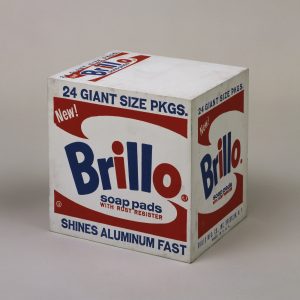
It appears to make a revolutionary and ludicrous demand, not to overturn the Society of artworks so much as to be enfranchised in it, claiming equality of place with sublime objects. … that so base and lumpen an object should be in enfranchised by admission to the art world seems out of the question. But then we recognise that we have confused the artwork—“Brillo Box”—with its vulgar counterpart in commercial reality. The work vindicates its claim to be art by propounding a brash metaphor: the brillo-box-as-work-of-art.[6]
Danto’s book, The Transfiguration of the Commonplace, unpacks the logic of such new appearances. It is well-worth reading and at the same time I would warn the reader to be ready for dense and refined arguments which help us to distinguish, for example, a work of art from a mere representation on his way to discovering the underlying logic of these new appearances in the world.
A key notion for Danto is the logic of artistic identification.[7] He uses an example of a common telephone book. He “elevates” it to art by artistic identification e.g. this book is now a novel or is now a paper sculpture, or is now a musical composition. This imaginative act of artistic identification is the same act that that a child (or the art world) does when he/she says, “this stick is a car!” With such a volitional act of the imagination, we enter a world and our future interpretations of the appearances within this world are accordingly logically bounded by the chosen genre. So, if the telephone book is now a novel we are entitled only to ask relevant questions concerning plot, grammar, etc. We may as Danto says, applaud the lack of verbs, deplore the multitude of characters, lack of suspense, etc. In the same manner of artistic identification, an ordinary brillo box becomes “Brillo Box”—a work of art now subject to artistic interpretation.
Danto then makes a crucial move: what marks the difference between Warhol’s “Brillo Box”—an artwork and another, outwardly identical Brillo box, which is not an artwork. His thesis is that the difference lies in what each is about. While the ordinary brillo box is simply about the contents it is representing, Warhol’s work is expressing something about the means of representation i.e. the labelled box.
This is a subtle shift in consciousness from contents to medium (linguistically from semantics to syntax). Another example: Suppose a newspaper item is framed and placed in a Gallery, then the artistic focus has shifted from the contents of the newspaper, to the newspaper itself as the chosen medium for such contents. We become awake to the way everyday news items are presented to us.
This shift in consciousness from contents to media, as marking much contemporary art, is, as Danto shows us, a complete negation of a long history in art of making the medium completely transparent or invisible so that we see through the invisible medium to the contents. For example, we are traditionally not to be drawn to the paint but to what has been painted. We are not to give our attention to the marble (material substrate) but to the sculptural form.
Now, in contemporary art, our attention is being drawn to the medium itself, e.g. “it’s black paint’, bringing to an end a long tradition of representational art in which the represented prevails over the representation, or medium.
These new appearances, then, neither being empirical objects nor their facsimiles in art, as Danto says, must be artistic representations of what we might call the medium of expression—of any content at all. It seems that contemporary art world is therefore showing us something new about both ourselves and the interiority of our world:
As a work of art, the Brillo Box does more than insist that it is a brillo box under surprising metaphoric attributes. It does what works of art have always done—externalising a way of viewing the world, expressing the interior of a cultural period, offering itself as a mirror to catch the conscience of our kings.[8]
Elsewhere, Danto says that artworks are embodied meaning, eliciting interpretations designed to “grasp the intended meaning they embody.” Together these quotes suggest the following to me. An ordinary commonplace object in the world is made into an “artwork” by an act of productive imagination—an artistic identification. This act opens us up to a world of embodied meaning that belongs to and is constrained by the artwork. Relevant interpretations are thus released bringing us closer to the essential “meaning” of the real object-now art object—i.e. its interiority:
What makes it art ? And why need Warhol make these things anyway? Why not just scrawl his signature across one? Or crush one up and display it as Crushed Brillo Box (“A protest against mechanization . . . ” ) or simply display a Brillo carton as Uncrushed Brillo Box ( ” A bold affirmation of the plastic authenticity of industrial . . . ” )? Is this man a kind of Midas, turning whatever he touches into the gold of pure art? And the whole world consisting of latent artworks waiting, like the bread and wine of reality, to be transfigured, through some dark mystery, into the indiscernible flesh and blood of the sacrament? Never mind that the Brillo box may not be good, much less great art. The impressive thing is that it is art at all. But if it is, why are not the indiscernible Brillo boxes that are in the stockroom? Or has the whole distinction between art and reality broken down?[9]
In my view the “opening up of a world” through an act of artistic identification, with a corresponding release of relevant interpretations that spring from the meaning embodied as the new real appearance, constitutes the gateway into the “interior of our cultural period”. The flow of interpretations emanating from the meaning “embodied” in the real object, as the real object constitutes the transfiguration of the commonplace that Danto is pointing to: “And the whole world consisting of latent artworks waiting, like the bread and wine of reality, to be transfigured, through some dark mystery, into the indiscernible flesh and blood of the sacrament?”
In depth psychological language, we are seeing, in these new appearances that Danto identified from within the art world, a new human potential for gaining conscious access to the living psyche as such, the living invisible medium informing the real object and emanating from it when the object is transfigured by a human act of artistic identification.
Danto produces many striking examples of this new capacity of ours to participate with the living psyche in its essential mode of being as movement—that movement as the “within-ness” of the new appearances. In one vivid thought experiment, he opens a Gallery showing several red painted squares, identical in appearance to the senses but with different titles (read: artistic identification). One is Israelites Crossing the Red Sea, as described by Kierkegaard who tells us that the Israelites had already crossed over and the Egyptian army already drowned. He remarks that his life is just like that painting. Next to it in Danto’s imaginary Gallery is an identical red square entitled Kierkegaard’s Mood. There are several more identical red squares lined up in this Gallery each with its own title: Red Square (as in Moscow), Nirvana, Red Table Cloth, and so on.[10]
Each of these titles performs an act of artistic identification by the artist, opening up a world to us. Through the gateway to each world flows relevant “interpretations” the thinking of which we may participate and thus experience the objective psyche in its essence as movement. We can wonder about the violence with which the Red Sea closed on the Egyptians and compare that violence with the uncanny calm that we “see” before us now. We can applaud the escape of the Israelites and pray for their safety. This release of autonomous meaning into consciousness (as happened to me as I now write this) is a very different process from what seems to have happened in art criticism since Danto’s pioneering work. One of the annoying traits of modern art criticism lies in the opinionated interpretations of contemporary art, seeming to reflect only the critics’ taste and prejudices and projected onto the artwork, i.e. not released as the interiority of the artwork following an artistic identification.
Danto’s secret of the transfiguration of the commonplace lies in his discovery of a new appearance in the world—a real object that is neither simply empirical (and mute) nor ideal (speaking to us but disembodied). He has shown us that the art world, unbeknown to itself, has accepted the presence of a new real appearance that, once constituted through an act of artistic identification (volitional act of imagination), becomes a unique world with infinite depths of meaning that pours out though our waking participation in its movement.
“Empirical” objects with interiority, infinite depth of meaning, awaiting our participation through a conscious act of participation on our part! His claim of “And the whole world [of ordinary empirical objects—my insert] consisting of latent artworks waiting, like the bread and wine of reality, to be transfigured, through some dark mystery, into the indiscernible flesh and blood of the sacrament” seems now within our reach.
[See my essay on Participatory Consciousness for my early attempts to “say” what Danto is saying here]
[1] See my 2016 essay, The Light within Our Ever-Darkening Shadow:
[3] Arthur C. Danto: The Transfiguration of the Commonplace: a philosophy of art. (Harvard University Press, 1981), Preface, viii.
[4] Arthur C. Danto: “The Artworld” in The Journal of Philosophy, Volume 61, Issue 19, American Philosophical Association Eastern Division Sixty-First Annual Meeting (Oct. 15, 1964), 571-584.
[5] Ibid, 574.
[6] Danto: Transfiguration of the Commonplace, 208.
[8] Danto: Transfiguration of the Commonplace, 208.
[9] Danto. The Artworld. 580.
[10] Danto: Transfiguration of the Commonplace, p.1
