
 Nietzsche prophesied the “death of God” and understood that humans must find a new mode of being, a new world, given this collapse in the West of our highest value. A collapse of a stable world leads to chaos and the rise of prophecy and art as pointers to new worlds. Contemporary artists are showing us a vast and mystifying range of artworks that portray nascent worlds coming into being and just as quickly disappearing into oblivion. One world that seems to be gaining some traction is the world of the posthuman. Contemporary art is giving us hints of this still-forming world in artworks produced from a collision between, or interpenetration of, virtual or technological reality and empirical reality, giving rise to weird, horrific, and sometimes strangely beautiful forms.
There are four phases involved in any world’s coming to be:
- Surrender and participation with the transformations within the “source of all”, for want of a better expression, thus becoming a receiver or vessel for an as-yet-unborn possible future. This is a process of initiation.
- Speaking as a mouthpiece of an unborn future. This is the work of revelation and prophecy.
- Willingness on the part of others to make a move towards further articulation or manifestation of that unborn future or world. This is the work of art.
- The gradual development of cultural practices based on the fresh appearances, giving further expression to and strengthening the new reality. This is the work of maintenance.
When these conditions are met then we end up living in that real world, taking the new appearances for granted and getting shaped by them. It becomes really so! In the light of these new strange appearances in contemporary posthuman art, we should pause as we consider the words of Owen Barfield:
Imagination is not, as some poets have thought, simply synonymous with good. It may be either good or evil. As long as art remained primarily mimetic, the evil which imagination could do was limited by nature . . . but [since non-representational art—my insert] both the good and evil latent in the working of imagination begin to appear unlimited… We could very well move forward into a chaotically empty or fantastically hideous world…. We should remember this, when appraising the aberrations of the formally representational arts…. in so far as they are genuine, they are genuine because the artist has in some way experienced the world he represents. And in so far as they are appreciated, they are appreciated by those who themselves are willing to make a move towards seeing the world in that way and, ultimately therefore, seeing that kind of world. We should remember this, when we see pictures of a dog with six legs emerging from a vegetable marrow or a woman with a motor-bicycle substituted for her left breast.[i]
With this in mind, I was shocked to read about a new development taking place in China, a change that demonstrates the chilling results of “the gradual development of cultural practices based on the fresh appearances, giving further expression to and strengthening the new reality. This is the work of maintenance.” (see point 4 above)
CHINESE SCIENTISTS CLONED GENE-EDITED MONKEYS WITH HORRIFYING RESULTS
Almost exactly one year ago, the world met Hua Hua and Zhong Zhong, the first primates cloned through a technique that could theoretically produce an unlimited number of replicas. Now, a team of Chinese scientists has used the same technique to produce five clones of another monkey, one genetically altered to have a disorder with an array of traumatic psychological side effects—and the research is a horrifying ethical minefield.
Accompanying this news item is a horrifying video:
Compare the video with this contemporary artwork:
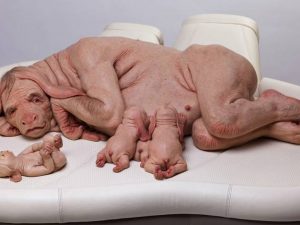
As we gaze at this piteous sight, we can also begin to feel how fast things are moving towards manifesting a posthuman world of stupendous horror.
For another possible outcome see my essay Jung and the Posthuman:
[i] Barfield, O. (1957). Saving the Appearances, 145-146. London: Faber and Faber.
